You are certainly familiar with the notion of open and closed intervals in \(\mathbb R\text{.}\) In this section we want to generalise these notions to subsets of \(\mathbb R^N\text{.}\) We call an interval \(I\subset\mathbb R\) open, if its endpoints do not belong to \(I\text{.}\) Hence, if we pick an arbitrary point in \(x_0\in I\) and move a little bit to the left or to the right we stay in the interval. Mathematically we can express this by saying that for every \(x_0\in I\) there exists a small interval \((x_0-\varepsilon,x_0+\varepsilon)\) which is entirely contained in \(I\text{.}\) If \(I\) is an arbitrary interval we call such a point \(x_0\in I\) an interior point of \(I\text{.}\) The same ideas can be applied to subsets of \(\mathbb R^N\text{.}\) A point \(\vect x_0\) in \(U\subset\mathbb R^N\) is called an interior point if we can move a little bit in every direction without immediately leaving \(U\text{.}\) Mathematically we can express this by requiring that a small ball about \(\vect{x_0}\) be entirely contained in the set \(U\text{.}\)
If \(N=1\) then \(B_r(x_0)\) is simply the interval \((x_0-r,x_0+r)\text{.}\) If \(N=2\) then \(B_r(\vect x_0)\) is an (open) disc centred at \(\vect x_0\) with radius \(r\text{,}\) and for \(N=3\) it is really a ball. We could distinguish between these different cases and expressions, but it is more convenient to call \(B_r(\vect x_0)\) simply a “ball”, no matter what the ‘dimension’of the space is.
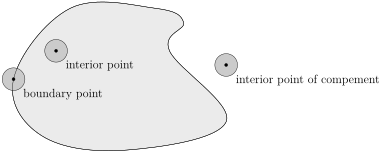
We call \(\vect x_0\) an interior point of \(U\subset\mathbb R^N\) if there exists \(\varepsilon\gt 0\) such that \(B_\varepsilon(\vect x_0)\subset U\text{.}\) The set of all interior points of \(U\) is called the interior of \(U\). We denote the interior of a set by \(\Int(U)\text{.}\)
A set \(U\subset\mathbb R^N\) is said to be an open set if all its points are interior points. In other words, \(U\) is open if and only if \(U=\Int(U)\text{.}\)
If \(I\) is an interval, its endpoints may or may not belong to it. In any case they play a special role. They are the points where we can ‘enter’ or ‘exit’ the interval with an arbitrarily small move. The set of all endpoints of an interval we also call the boundary of the interval. For subsets of \(\mathbb R^N\) the boundary is defined the same way, namely as the set of points, where we can ‘enter’ or ‘exit’ the set with an arbitrarily small move. Here is a precise mathematical definition.
Let \(U\subset\mathbb R^N\text{.}\) Points in \(\mathbb R^N\) which are not interior points of \(U\) or its complement are called boundary points of \(U\text{.}\) The set of boundary points of \(U\) is denoted by \(\partial U\text{,}\) and is called the boundary of \(U\).
In Figure 3.11 interior and boundary points of a set in \(\mathbb R^2\) are shown, together with a ball centred at them as required in the definition. Note that, as we get close to the boundary of the set the balls about an interior point might be very small.
Moreover, as with the endpoints of an interval, the boundary of a set may or may not belong to the set. Sometimes only part of the boundary of a set belongs to the set, as with a half open interval.
A set \(U\subset\mathbb R^N\) is called a closed set or closed if \(\partial U\subset U\text{.}\) Equivalently, we can say \(U\) is closed if the complement of \(U\) is open.
The closure of a set \(U\subset\mathbb R^N\) can also be characterised as the smallest closed set containing \(U\text{.}\) Moreover, note that \(U=\closure U\) if \(U\) is a closed set, and that \(U=\Int(U)\) if \(U\) is open.
The intervals \((1,4)\text{,}\)\((2,\infty)\) or \((-\infty,10)\) are open sets in \(\mathbb R\text{,}\) whereas \([1,4]\text{,}\)\([2,\infty)\) or \((-\infty,10]\) are closed sets in \(\mathbb R\text{.}\) The last three sets are in fact the closures of the first three sets.
The set \(U:=\{1/n\mid n\in\mathbb N\}\) is not open and not closed in \(\mathbb R\text{.}\) Zero does not belong to the set \(U\text{,}\) but for every \(\varepsilon\gt 0\) the intersection \(U\cap(-\varepsilon,\varepsilon)\) is non-empty. Hence zero is not an interior point of the complement. It is also not an interior point, and thus it belongs to the boundary of \(U\text{.}\) The set \(U\cup\{0\}\) is a closed set, in fact it is the closure of \(U\text{.}\) The set does not have interior points as every interval about a point in \(U\text{,}\) no matter how small, contains a point not in \(U\text{.}\) Hence \(\closure U=U\cup\{0\}=\partial U\text{.}\) Visualise the situation by drawing a picture!
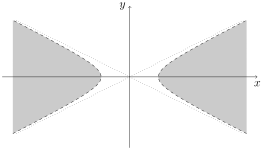
The set \(U:=\{(x,y)\in\mathbb R^2\mid x^2-4y^2\gt 1\}\) is an open set in \(\mathbb R^2\text{.}\) It can be characterised as the set of points, \((x,y)\text{,}\) satisfying \(|x|\gt \sqrt{4y^2+1}\text{.}\) The shaded part in Figure 3.18 is the set, and the dashed line is its boundary.
The line segment \(\{(x,0)\in\mathbb R^2\mid x\in(0,5)\}\) is not open and not closed in \(\mathbb R^2\text{.}\) It has no interior. Its boundary is \(\{(x,0)\in\mathbb R^2\mid x\in[0,5]\}\text{.}\) This is in contrast to the interval \((0,5)\) in \(\mathbb R\) which is open, and whose boundary is the set \(\{0,5\}\text{.}\) Hence ‘boundary’, ‘interior’ and ‘closure’ depend on the underlying space.