According to
(1.6) the area,
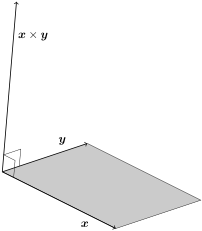
\(A\text{,}\) of the parallelogram spanned by
\(\vect x\) and
\(\vect y\) is given by
\begin{equation*}
A=\sqrt{\|\vect x\|^2\|\vect y\|^2-(\vect x\cdot\vect y)^2}\text{.}
\end{equation*}
We then use the definition of the scalar product, the norm and the cross product, and rearrange the terms in the square root:
\begin{align*}
A^2\amp =\|\vect x\|^2\|\vect y\|^2-(\vect x\cdot\vect y)^2\\
\amp =(x_1^2+x_2^2+x_3^2)(y_1^2+y_2^2+y_3^2)-(x_1y_1+x_2y_2+x_3y_3)^2\\
\amp =x_1^2y_1^2+x_1^2y_2^2+x_1^2y_3^2 +x_2^2y_1^2+x_2^2y_2^2+x_2^2y_3^2 +x_3^2y_1^2+x_3^2y_2^2+x_3^2y_3^2\\
\amp \qquad -(x_1^2y_1^2+x_2^2y_2^2+x_3^2y_3^2+2x_1x_2y_1y_2+2x_1x_3y_1y_3+2x_2x_3y_2y_3)\\
\amp =x_1^2y_2^2+x_1^2y_3^2 +x_2^2y_1^2+x_2^2y_3^2 +x_3^2y_1^2+x_3^2y_2^2\\
\amp \qquad-2x_1x_2y_1y_2-2x_1x_3y_1y_3-2x_2x_3y_2y_3\\
\amp =(x_2y_3-x_3y_2)^2+(x_3y_1-x_1y_3)^2+(x_1y_2-x_2y_1)^2\\
\amp =\|\vect x\times\vect y\|^2\text{.}
\end{align*}
This shows
(1.12). To show that the triple
\((\vect x,\vect y,\vect x\times\vect y)\) is positively oriented we apply
(1.10) to the matrix with columns
\(\vect x\text{,}\) \(\vect y\) and
\(\vect z=\vect x\times\vect y\text{.}\) Then using the definition of the norm
\begin{equation*}
\det
\begin{bmatrix}
x_1\amp y_1\amp x_2y_3-x_3y_2\\
x_2\amp y_2\amp x_3y_1-x_1y_3\\
x_3\amp y_3\amp x_1y_2-x_2y_1
\end{bmatrix}
=(\vect x\times\vect y)\cdot(\vect x\times\vect y)
=\|\vect x\times\vect y\|^2
\geq 0\text{,}
\end{equation*}
and thus the triple is positively oriented.