Suppose that \(\vect f=(f_1,f_2)\) is a smooth vector field. Applying Green’s theorem to the field \((-f_2,f_1)\) we obtain
\begin{equation*}
\iint_D\Bigl(\frac{\partial}{\partial x_1}f_1
+\frac{\partial}{\partial x_2}f_2\Bigr)\,dx_1\,dx_2
=\int_{\partial D}f_1\,dx_2-f_2\,dx_1\text{.}
\end{equation*}
We want to get an interpretation of the integral on the right hand side. To do so suppose that
\begin{equation*}
\vect\gamma(t)=(\gamma_1(t),\gamma_2(t)),\qquad t\in[a,b]
\end{equation*}
is a regular parametrisation of some part \(C\subset\partial D\) consistent with the orientation of \(\partial D\text{.}\) By definition of the line integral we have
\begin{equation*}
\int_{C}f_1\,dx_2-f_2\,dx_1
=\int_a^bf_1(\gamma_1(t),\gamma_2(t))\gamma_2'(t)
-f_2((\gamma_1(t),\gamma_2(t))\gamma_1'(t)\,dt\text{.}
\end{equation*}
We can view the integrand on the right hand side as a dot product of \(\vect f\) with the vector \((\gamma_2'(t),-\gamma_1'(t))\text{.}\) We rescale the latter to unit length and define
\begin{equation*}
\vect n(t):=\frac{1}{\|\vect\gamma'(t)\|}
\begin{bmatrix}
\gamma_2'(t) \\-\gamma_1'(t)
\end{bmatrix}\text{.}
\end{equation*}
Observe that
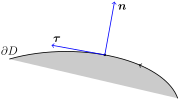
\(\vect n(t)\) is perpendicular to the positive unit tangent vector
\(\vect\tau(t)=\vect\gamma'(t)/\|\gamma'(t)\|\text{.}\) As it is outward pointing, it is called the
outward pointing unit normal to
\(D\text{.}\) Both vectors are shown in
Figure 11.1.
Hence we can rewrite our integral as
\begin{equation*}
\int_{C}f_1\,dx_2-f_2\,dx_1
=\int_a^b\vect f(\vect\gamma(t))
\cdot\vect n(\vect\gamma(t))\|\vect\gamma'(t)\|\,dt
\end{equation*}
\begin{equation}
\int_{C}f_1\,dx_2-f_2\,dx_1
=\int_C\vect f\cdot\vect n\,ds\text{.}\tag{11.1}
\end{equation}
Let
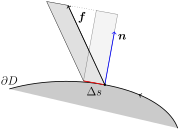
\(\Delta s\) denote a very small line element. If
\(\vect f\) models the motion of a fluid (direction and velocity of fluid at a given point) then
\(\vect f\cdot\vect n\Delta s\) is the flux across
\(\partial D\) through the line element
\(\Delta s\text{,}\) and
\(\vect f\cdot\vect n\Delta s\) is the approximate amount of fluid flowing across the boundary
\(\partial D\) through
\(ds\text{.}\) The situation is depicted in
Figure 11.2. Note that the area of the parallelogram and the rectangle are the same.
Hence the integral on the right hand side of
(11.1) represents the total flux of
\(\vect f\) across
\(C\subset \partial D\text{.}\) Note that the above arguments are completely analogous to those used in
Section 9.6 to find the flux of a vector field in space across a surface. Going back to the original formula we see that
\begin{equation*}
\iint_D\Bigl(\frac{\partial}{\partial x_1}f_1
+\frac{\partial}{\partial x_2}f_2\Bigr)\,dx_1\,dx_2
=\int_{\partial D}\vect f\cdot\vect n\,ds
\end{equation*}
is the total loss (or increase) of the fluid from \(D\) through \(\partial D\text{.}\) We make the following definition.
Definition 11.3. Divergence of a vector field.
If \(\vect f=(f_1,\dots,f_N)\) is a vector field in \(\mathbb R^N\) then
\begin{equation*}
\divergence\vect f:=\frac{\partial}{\partial
x_1}f_1+\frac{\partial}{\partial x_2} f_2+\dots
+\frac{\partial}{\partial x_N} f_N
\end{equation*}
is called the divergence of the vector field.
Theorem 11.5. Divergence Theorem.
If \(\vect f\) is a smooth vector field defined on a piecewise smooth domain \(D\) then
\begin{equation*}
\int_D\divergence\vect f(\vect x)\,d\vect x
=\int_{\partial D}\vect f\cdot\vect n\,ds\text{,}
\end{equation*}
where \(\vect n\) is the outward pointing unit normal vector to \(\partial D\text{.}\)