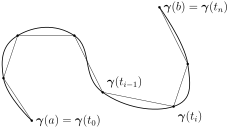
In this section we want to define arc length, that is, the length of a curve. We suppose that \(\vect\gamma(t)\text{,}\)\(t\in [a,b]\text{,}\) is a regular parametrisation of a smooth curve \(C\text{.}\) To find its length we choose a partition \(a=:t_0\lt t_1\lt t_2\lt \dots\lt t_n:=b\text{.}\) We then approximate \(C\) by the polygon with vertices \(\vect\gamma(t_{i})\) as shown in Figure 7.6.
The length of the line segment connecting \(\vect\gamma(t_{i-1})\) to \(\vect\gamma(t_i)\) is \(\|\vect\gamma(t_i)-\vect\gamma(t_{i-1})\|\text{,}\) so the total length of the polygon is
The length of the polygon will always be smaller than the length of the curve as we always take a `shortcut’ from one point to the next on the polygon. If we take a finer partition, that is, make \(\max(t_{i}-t_{i-1})\) smaller, we expect to get a closer approximation of the length of \(C\text{.}\) This motivates the following definition.
The above definition is not very handy to compute the length of \(C\text{.}\) Using that the curve is smooth we want to derive a formula to compute its length. Setting \(\Delta t_i:=t_i-t_{i-1}\) we can rewrite (7.2) as
as \(\max\Delta t_i\) tends to zero. With some effort involved to estimate the error terms in the above procedure one can show that in fact the following is true.
Suppose that \(\vect\gamma(t)\text{,}\)\(t\in[a,b]\) is a regular parametrisation of the smooth curve \(C\text{.}\) Then the length, \(L(C)\text{,}\) of \(C\) is given by
Note that the length of a curve is independent of the orientation of the curve. To compute the length of a piecewise smooth curve we add up the lengths of all its smooth parts.
Let us finally look at two special cases of the above formula. First assume that \(f\) is a continuously differentiable function on the interval \([a,b]\text{.}\) Then the function
defines a smooth curve in \(\mathbb R^2\text{,}\) namely the graph of \(f\text{.}\) It follows that \(\vect\gamma'(t):=(1,f'(t))\text{,}\) and applying Proposition 7.8 we see that the
\begin{equation*}
\text{Length of the graph of }f
=\int_a^b\sqrt{1+(f'(t))^2}\,dt\text{.}
\end{equation*}
Next we suppose that the curve is given in polar coordinates, that is, the radius as a function of the angle: \(r=f(\varphi)\text{,}\)\(\varphi\in[\alpha,\beta]\text{.}\) Then \(x=r\cos\varphi=f(\varphi)\cos\varphi\) and \(y=r\sin\varphi=f(\varphi)\sin\varphi\text{,}\) so
\begin{equation*}
\text{Length of the curve }r=f(\varphi)\text{ is }
\int_\alpha^\beta
\sqrt{\bigl(f(\varphi)\bigr)^2+\bigl(f'(\varphi)\bigr)^2}\,d\varphi\text{.}
\end{equation*}