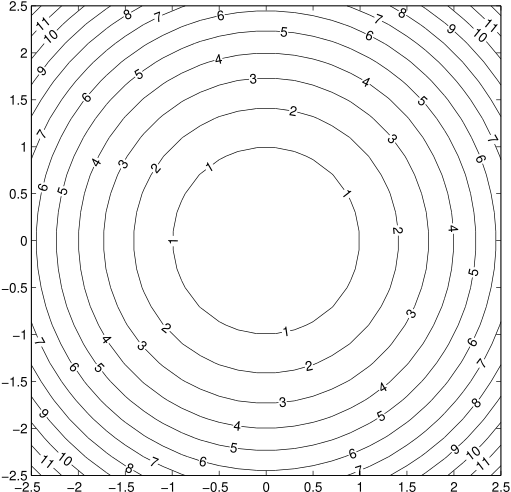
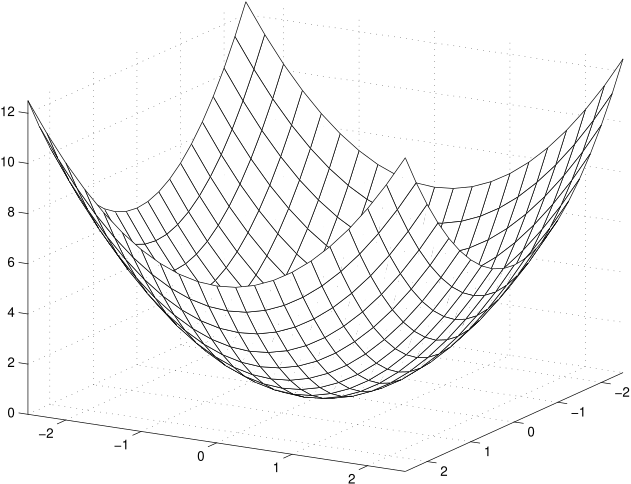
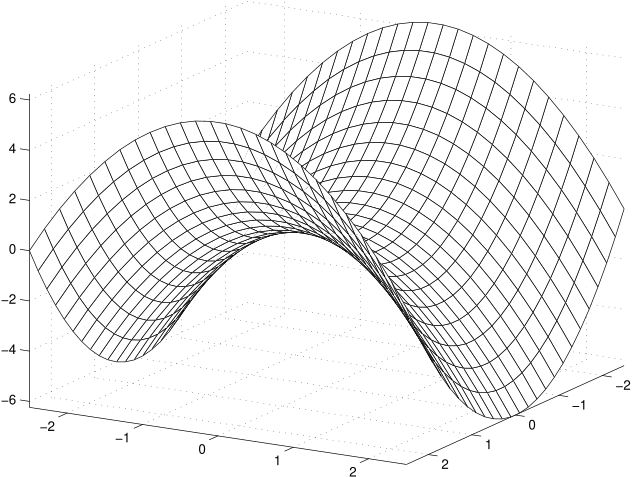
Looking at Figure 2.2 we see that the graph looks like the topography of a mountain range. On maps the topography is usually represented by lines of equal altitude. We can do this as well in our case. We specify a “level”\(c\) and look at the set of all \((x,y)\in D\) such that \(f(x,y)=c\text{.}\) Such a line is called a contour line. Drawing several such lines for equally spaced levels we get what we will call a contour map. The contour map of the function from Figure 2.2 is depicted in Figure 2.3. The numbers on the contour lines indicate their levels.
The contour “line” for \(c=0\) just consists of one point, namely \((0,0)\text{.}\) As \(x^2+y^2\geq 0\) for all \((x,y)\) the contour line for \(c=-1\) is empty. For \(c=1\) the contour line is a circle about the origin with radius one.
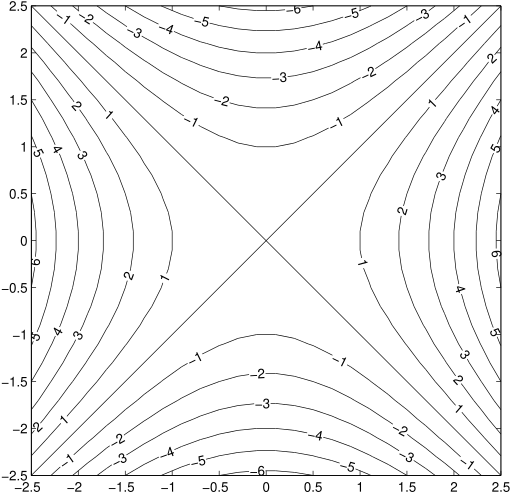
We have to solve the equations \(c=x^2-y^2\text{.}\) For \(c=0\) we have the lines \(y=\pm x\text{.}\) If \(c\gt 0\) then we have \(x=\pm\sqrt{y^2+c}\text{,}\) so we get a pair of hyperbolas. Similarly, if \(c\lt 0\) we have \(y=\pm\sqrt{x^2-c}\) which is defined everywhere since \(-c\gt 0\text{.}\) Hence we have another pair of hyperbolas, but turned by \(90^\circ\) as shown in Figure 2.7.